
Granddad Said: Buy the Right Tool for the Job Once—Don’t Waste Your Money on Inferior Gear
Portable centrifuges, preheaters, and custom field packages can all have legitimate uses. The important question is whether the finished equipment is actually suited to the measurement work you intend to perform.
Buy the Right Tool for the Job Once
There is an old piece of advice that has probably been repeated in machine shops, garages, oil fields, and farm shops for generations:
Buy the right tool for the job once.
It is good advice because the least expensive tool on the shelf is not always the least expensive tool to own.
Field centrifuges are a good example.
Over the years, we have encountered a number of field centrifuge packages assembled from a portable centrifuge, a separate sample preheater, and a carrying case or fabricated enclosure. Around here, we sometimes jokingly refer to them as “Frankenstein centrifuges.”
That name is not intended as an insult.
In fact, some of these systems have been assembled using W.L. Walker portable centrifuges and Walker preheaters. We manufacture those products, we sell them, and they have legitimate applications.
The question is not whether someone is allowed to put these components together.
Is the finished system the right tool for the work you intend to perform?
Not Every Centrifuge Application Is the Same
API MPMS Chapter 10.4 describes the field centrifuge procedure for determining water and/or sediment in crude oil.
That does not mean every centrifuge used anywhere in the oil field must conform to Chapter 10.4.
API standards are industry standards. The requirements that govern a measurement operation can depend on the contract between the parties, applicable regulations, company procedures, and the particular purpose for which the measurement is being made.
Naturally, two parties may agree to a particular measurement procedure where regulations or other controlling requirements permit them to do so.
Likewise, equipment being used for an internal process check, troubleshooting, training, approximate field information, or another non-custody-transfer purpose may have very different requirements from equipment being used to determine a contractual quantity.
So an assembled portable centrifuge system may be entirely suitable for someone's application.
Do not assume that putting a portable centrifuge and a preheater in the same box automatically creates an API MPMS Chapter 10.4 field centrifuge.
RPM Is Only Half the Story
One of the first things an operator should understand is that centrifuge performance is not determined by RPM alone.
What matters is Relative Centrifugal Force, commonly abbreviated RCF.
The amount of centrifugal force produced depends on both the rotational speed and the effective diameter of the rotating assembly.
RPM, Diameter and Relative Centrifugal Force
For a centrifuge diameter expressed in inches, the relationship can be written as:
Or, rearranged:
This is why two centrifuges operating at the same RPM can produce very different centrifugal forces if their tip-to-tip diameters are different.
For example, a two-place head with an approximately 14.25-inch diameter produces roughly:
| Relative Centrifugal Force | Approximate RPM | Head Diameter |
|---|---|---|
| 500 RCF | 1,569 RPM | 14.25 in. |
| 600 RCF | 1,719 RPM | 14.25 in. |
| 700 RCF | 1,857 RPM | 14.25 in. |
| 800 RCF | 1,986 RPM | 14.25 in. |
A smaller portable centrifuge may require more RPM to develop the same centrifugal force.
Typically, portable units are equipped with smaller motors because they were originally developed to be mounted to a fence post to aid the pumper in quality determination before calling a gathering truck out.
For example, suppose a centrifuge has an effective rotating diameter of 10 inches and operates at 1,600 RPM:
That works out to only about 365 RCF.
To produce 500 RCF with that same 10-inch diameter, the centrifuge would need to turn approximately 1,874 RPM.
This is why a statement such as “the machine turns 1,600 RPM” tells you very little by itself.
You need to know the rotor geometry too.
Already Own One? Check It
If you already own an assembled portable centrifuge system, our advice is not to throw it away.
And be prepared to answer questions about it during an audit.
Determine the appropriate effective rotating diameter for the centrifuge head and verify the machine's actual operating RPM with suitable test equipment.
Then calculate the RCF.
Owners should consult the current applicable edition of API MPMS Chapter 10.4 and the manufacturer's instructions when determining the proper measurement points and acceptable operating conditions.
The current Fifth Edition of Chapter 10.4 was reaffirmed in 2025 and remains the applicable API field centrifuge procedure. The Fifth Edition also included revisions dealing with centrifuge tube spin calculations, test procedures, and reading requirements.
Measure what the machine actually does instead of assuming performance from the label on the motor or the appearance of the package.
Heating Matters Too
Centrifugation is only part of the procedure.
Preheating the centrifuge tubes to the proper temperature has a profound effect on test results. Maintaining that temperature during the spin is equally important.
A purpose-built heated field centrifuge is designed around both operations.
With an assembled system, the operator needs to understand exactly what the preheater does, what the centrifuge does, how quickly the samples lose heat after being transferred, and whether the complete procedure satisfies whatever requirements apply to that measurement.
Again, this does not mean a separate preheater is a bad product.
It simply means that a preheater and a portable centrifuge should not automatically be treated as equivalent to an integrated heated centrifuge without verifying the complete process.
The Enclosure Is Part of the Equipment
Another consideration is the enclosure itself.
We have seen portable centrifuges installed in plastic equipment cases as well as larger, single-walled fabricated aluminum boxes.
There may be applications where that arrangement is perfectly adequate.
There are also applications where centrifuge containment, heating, electrical configuration, and the location of controls become problematic.
Putting controls and other equipment immediately alongside an exposed rotating centrifuge head may cause the safety guy to have a heart attack on the spot.
In all seriousness, placing controls inside a machine designed to sling roughly a pound of mass at speeds exceeding 1,200 RPM deserves careful consideration.
Those realities should be considered when evaluating the complete assembly.
Different Ways to Package a Field Centrifuge
These examples illustrate why the complete configuration matters. A portable centrifuge and preheater can be packaged in several different ways, while a purpose-built heated field centrifuge integrates the equipment into a machine designed around the complete operation.
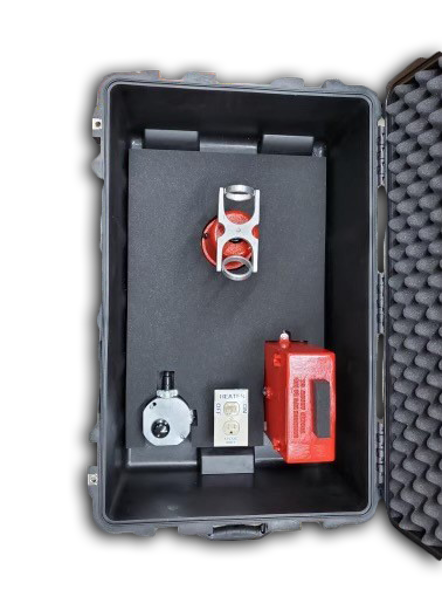
Pelican-Style Case Configuration
A portable centrifuge and separate preheater packaged together for field use. This type of arrangement may be perfectly suitable for some applications, but its RCF, temperature performance, enclosure, and complete configuration should be evaluated for the intended procedure.
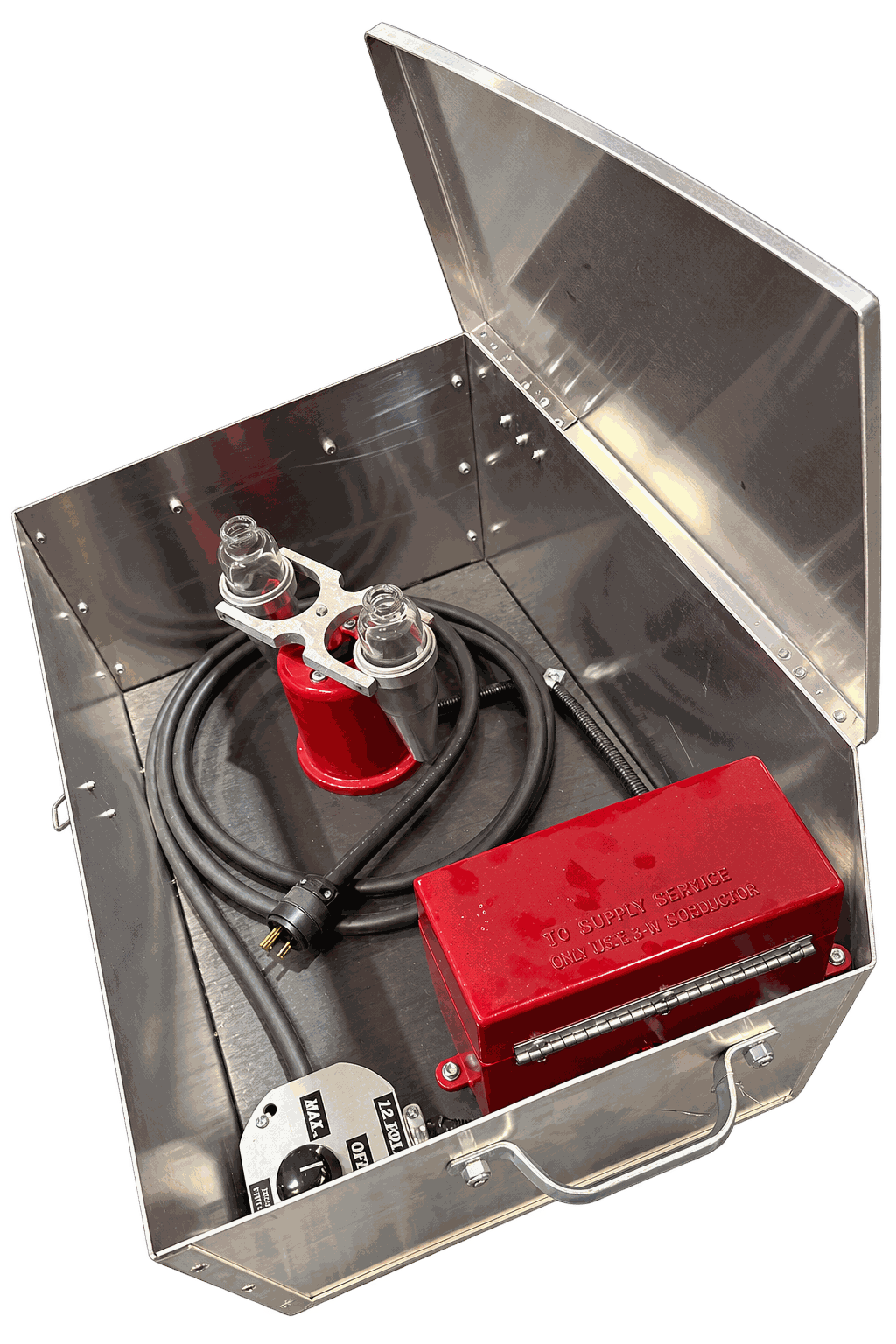
Fabricated Aluminum Configuration
A portable centrifuge and separate preheater packaged together inside a fabricated aluminum enclosure. This type of arrangement may be appropriate for some applications, but packaging the components together does not by itself establish the RCF, temperature performance, or overall suitability of the completed system.
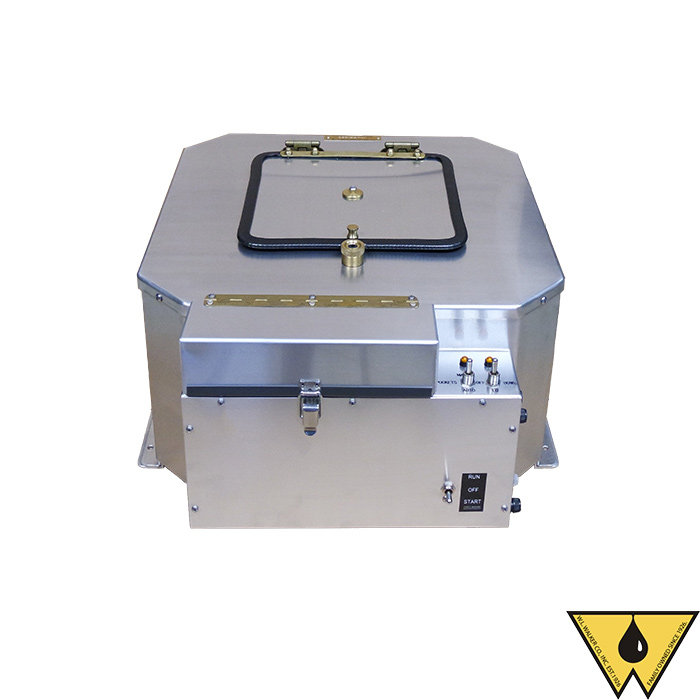
Walker Model 18721
The Walker 18721 is a compact, purpose-built heated field centrifuge designed around the centrifuging, heating, control, and enclosure requirements of the complete machine.
The portable configurations shown are examples of equipment encountered in the field. Their appearance alone does not determine whether they are suitable for a particular application. Users should verify the performance and requirements applicable to their own measurement procedure.
Are You Actually Saving Money?
This is where Granddad's advice comes back into the picture.
One assembled unit we recently encountered carried a price tag of approximately $2,200.
At the time of this writing, a Walker Model 18721, a purpose-built field centrifuge, is approximately $2,251.
Approximately $51 Separates the Two
For an application that requires the capabilities of a purpose-built Chapter 10.4 field centrifuge, saving approximately $51 by buying a hodgepodge system whose centrifugal force, heating capability, enclosure, or overall configuration may not meet your needs does not represent much of a savings at all.
There is another practical difference.
Purpose-built field centrifuges from Walker—and compliant equipment offered by other manufacturers—can also be considerably more compact than some of the large field packages assembled from multiple individual products.
The point is not that Walker is the only company capable of building a good centrifuge.
We admit that we are not.
But What If the Portable Arrangement Is Exactly What You Need?
Then we would rather help you build the right one.
There are situations where a portable centrifuge and preheater arrangement may make perfect sense.
Easier to Move
A smaller portable configuration may be easier to carry between locations or move between vehicles.
Different Work, Different Needs
The equipment may be used for work where Chapter 10.4 compliance is not required or where a different procedure has been agreed upon.
Faster Deployment
A simplified arrangement may provide a faster path for an operator who needs centrifuge equipment installed in a service or measurement truck.
Walker already manufactures the portable centrifuges and preheating equipment used in many of these arrangements.
So rather than fight a configuration that genuinely fits a customer's needs, we would rather understand the application and work with you to solve your centrifuging needs.
If a simplified version of the Walker 18721 would better fit your operation—or if you need a portable configuration that can be installed quickly in a truck—talk to us.
There may be a better way to package the equipment while still giving you the performance you need.
Buy the Tool for the Job You Actually Have
There is nothing inherently wrong with a portable centrifuge.
There is nothing inherently wrong with a separate preheater.
And there is nothing inherently wrong with combining equipment into a custom field package when that package is appropriate for the intended use.
The mistake is assuming that all centrifuges are interchangeable.
Before purchasing a field centrifuge, ask a few basic questions:
- What procedure am I expected to follow?
- Does API MPMS Chapter 10.4 apply to this measurement?
- What RCF does the centrifuge produce?
- Can the equipment, as configured, satisfy the necessary pre-spin sample-temperature and post-spin temperature requirements?
- Is the complete assembly appropriate for the environment where I intend to use it?
- Am I saving enough money to justify the compromise?
Sometimes the improvised tool really is the right tool. Sometimes it isn't.
Need Help Choosing a Centrifuge?
If a standard Walker 18721 or 18724 fits your application, we would be glad to help. If a simplified portable arrangement would serve you better, we would like to hear about that too. Our sales department can help evaluate the application and discuss a configuration that makes sense for the work you perform.
This article is intended as general technical information and is not a substitute for the applicable contract, regulation, manufacturer's instructions, or the current edition of API MPMS Chapter 10.4. Users are responsible for determining the requirements applicable to their particular measurement operation.